
 Italiano
 English
From:
11.20 €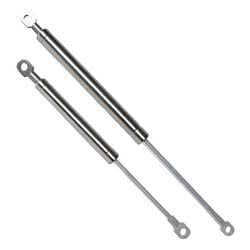
From:
28.70 €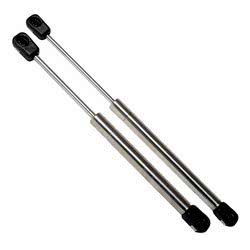
From:
22.30 €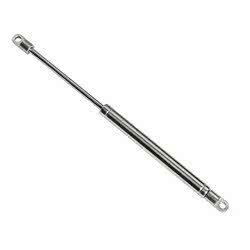
From:
199.30 €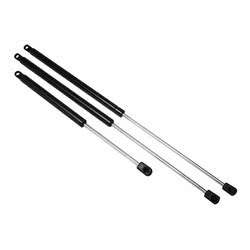
From:
8.00 €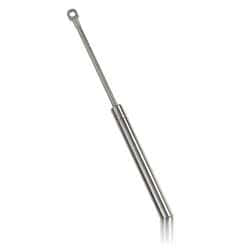
From:
47.80 €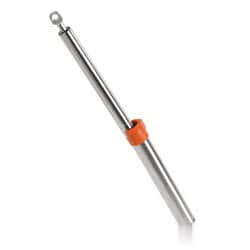
From:
12.20 €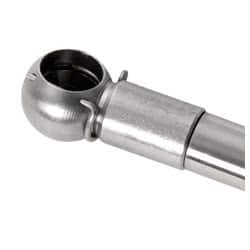
From:
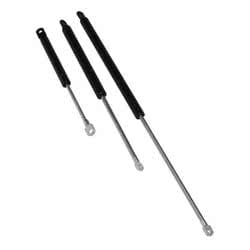
3.18 €gas struts or gas dampers, are a fundamental component for the assisted opening of hatches, lockers, and engine compartments on boats. A well-sized gas spring makes opening easier and safer, preventing sudden closures due to wind or rolling.Measure the total length of the gas spring when the locker is fully open (Open mm). Then, measure the distance the spring needs to compress when the locker is closed (Stroke mm). Finally, estimate the weight of the locker and choose a spring with a Reaction kg slightly higher than this weight to ensure the locker opens fully and stays open.
Technically yes, but it is not recommended. Car gas springs are not designed to withstand the marine environment, which is highly corrosive. Using a non-marine specific gas spring means it will rust quickly, losing effectiveness and potentially seizing. Always use gas springs specifically designed for marine use.
The ball socket fitting is more common and versatile. It consists of a metal ball at the end of the rod that attaches to a bracket or eyelet. The threaded fitting, on the other hand, has a male or female thread that screws directly onto the hatch or frame. The ball socket fitting offers greater flexibility in angle and alignment, while the threaded fitting is more rigid and requires precise alignment.
Absolutely not. In addition to the dimensions (Open mm and Stroke mm) and the force (Reaction kg), you must consider the material (those for nautical use are in stainless steel or with specific anti-corrosion treatments) and the type of fitting. Another, less obvious factor is the build quality: cheap springs can lose gas quickly, becoming useless in a short time.
Measure the total length of the gas spring when the locker is fully open (Open mm). Then, measure the distance the spring needs to compress when the locker is closed (Stroke mm). Finally, estimate the weight of the locker and choose a spring with a Reaction kg slightly higher than this weight to ensure the locker opens fully and stays open.
Technically yes, but it is not recommended. Car gas springs are not designed to withstand the marine environment, which is highly corrosive. Using a non-marine specific gas spring means it will rust quickly, losing effectiveness and potentially seizing. Always use gas springs specifically designed for marine use.
The ball socket fitting is more common and versatile. It consists of a metal ball at the end of the rod that attaches to a bracket or eyelet. The threaded fitting, on the other hand, has a male or female thread that screws directly onto the hatch or frame. The ball socket fitting offers greater flexibility in angle and alignment, while the threaded fitting is more rigid and requires precise alignment.
90% of the orders are shipped within 24H. Have a look at the availability and shipment time in the product page
We work on boating since 1982. You will find experienced and polite staff
You can choose between Paypal, Credit Card, Postepay and Transfer
We only use packaging from recycled material within our own store