
 Italiano
 English
From:
43.70 €
From:
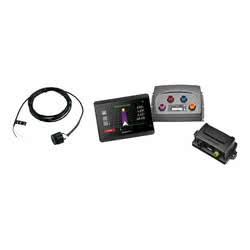
2306.70 €Garmin Reactor autopilots represent an advanced solution for navigation control, offering precision and reliability in diverse sea conditions. Whether you have mechanical or hydraulic steering, there's a Reactor model tailored to your needs. These systems are engineered for seamless integration with your Garmin onboard instruments, creating a complete and intuitive navigation experience. Upgrade your boat autopilot today!
The Reactor series stands out for its easy installation and ability to maintain course with accuracy, even in strong winds or heavy seas. Thanks to the solid-state heading sensor, the autopilot reacts quickly to changes in direction, ensuring smooth and stable navigation. Compact Reactor models are particularly well-suited for vessels with limited space, delivering the same high performance in a more compact form factor. This is the perfect boat autopilot for smaller vessels.
A common problem faced by boaters is the difficulty of maintaining course manually for extended periods. A Garmin Reactor marine autopilot solves this problem, allowing you to focus on other onboard tasks or simply enjoy the journey. Furthermore, its ability to integrate with other Garmin instruments, such as chartplotters, enables you to create complex routes and follow them automatically.
Autopilots for mechanical steering use a mechanical actuator to control the rudder, while those for hydraulic steering interface directly with the existing hydraulic system. The choice depends on the type of steering system installed on your boat.
Garmin autopilots integrate with chartplotters via NMEA 2000 connection. This connection allows for the sharing of information such as position, heading, and wind data, enabling the autopilot to follow complex routes and react to environmental conditions.
Solid-state heading sensors offer greater precision and reliability compared to traditional sensors. They are less sensitive to vibrations and boat movements, ensuring more stable and accurate navigation.
Autopilots for mechanical steering use a mechanical actuator to control the rudder, while those for hydraulic steering interface directly with the existing hydraulic system. The choice depends on the type of steering system installed on your boat.
Garmin autopilots integrate with chartplotters via NMEA 2000 connection. This connection allows for the sharing of information such as position, heading, and wind data, enabling the autopilot to follow complex routes and react to environmental conditions.
Solid-state heading sensors offer greater precision and reliability compared to traditional sensors. They are less sensitive to vibrations and boat movements, ensuring more stable and accurate navigation.
90% of the orders are shipped within 24H. Have a look at the availability and shipment time in the product page
We work on boating since 1982. You will find experienced and polite staff
You can choose between Paypal, Credit Card, Postepay and Transfer
We only use packaging from recycled material within our own store